Why Your Post-Run Socks Matter More Than Your Shirt

Quick Answer: Your feet produce a disproportionate amount of sweat, sit inside a sealed shoe with nowhere for it to go, and lose heat faster than the rest of you once you stop moving. That combination makes wet socks the single most uncomfortable thing you are still wearing ten minutes after a run - and the most likely to cause skin problems. Changing socks and shoes first, before the shirt, solves more discomfort per second than any other post-run change. It takes about forty seconds.
Most runners have a well-developed opinion about post-run tops and no plan at all for their feet.
The ranking is upside down.

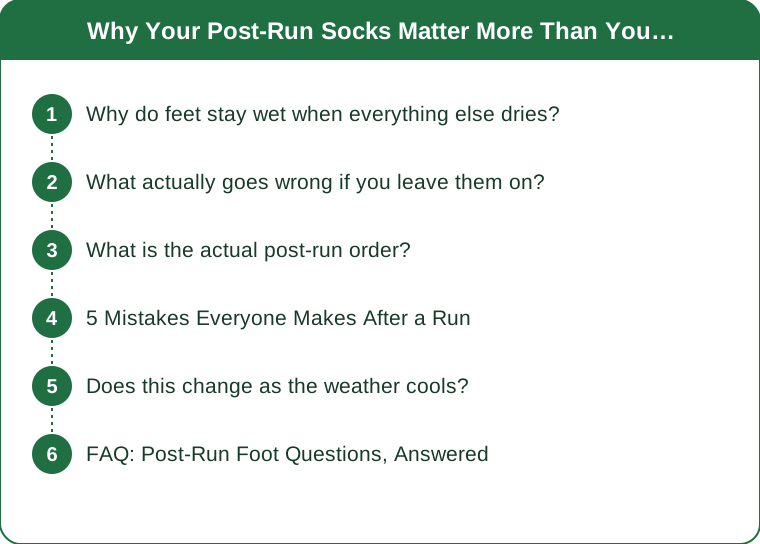
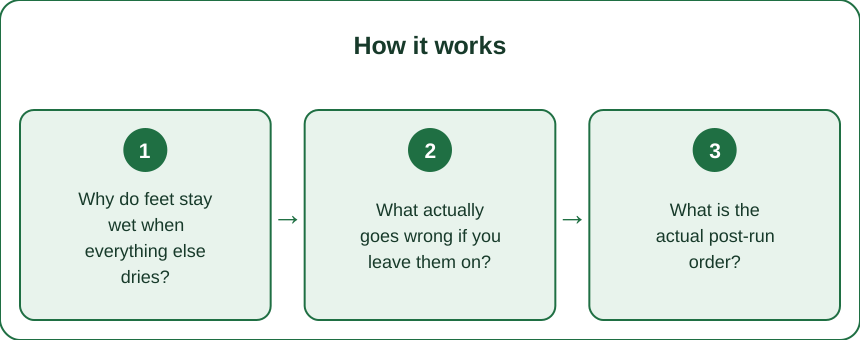
Why do feet stay wet when everything else dries?
Because of sweat gland density and the fact that a shoe is a closed system.
The soles of your feet have among the highest concentrations of sweat glands anywhere on the body. Estimates commonly put it in the range of hundreds of glands per square centimetre - substantially denser than your back or chest. Your feet are producing sweat at a high rate for their surface area, and they do it whether or not you feel hot.
Then that sweat has nowhere to go. A running shoe, even a well-ventilated one, is effectively a sealed container around a warm damp environment. Your shirt is exposed to moving air and dries continuously; your sock is not. By the end of an hour, the sock is saturated and holding moisture directly against skin.
When you stop, the situation gets worse rather than better. Blood flow to the extremities drops as your body redirects it, so your feet cool faster than your core while still sitting in wet fabric. That is the specific sensation of feet feeling cold and clammy fifteen minutes after a run when the rest of you feels fine.
Meanwhile the shirt you are so focused on is doing the least harm. It is loose, exposed to air, and drying by the minute.
What actually goes wrong if you leave them on?
Three things, in ascending order of annoyance.
Skin maceration. Prolonged moisture softens the outer layer of skin and makes it fragile. Macerated skin blisters and tears far more easily than dry skin, which is why the blister you get on Tuesday often started as an hour of damp on Monday. Runners who never change socks post-run tend to have persistently soft, vulnerable skin on the ball of the foot.
Fungal conditions. Warm, dark, and damp is the exact set of conditions that favours athlete’s foot. The single most effective preventive measure is reducing the total hours per week your feet spend wet - and post-run time is easily half of that total for a regular runner.
Odour that transfers. Bacteria feeding on sweat produce the smell, and damp socks left in a bag will pass it to everything else in there. This is why a gym bag smells even after the clothes have been washed.
None of these is dramatic and all of them are cumulative. They also all respond to the same forty-second intervention, which is the reason it is worth making automatic.
If your feet are already showing persistent itching, peeling, or cracked skin, that is worth a professional opinion rather than a sock change. This is general information, not medical advice.
What is the actual post-run order?
Feet, then torso, then layers. Here is the sequence that solves the most discomfort fastest.
1. Shoes off, socks off, immediately. Even before you have your keys down. Air on bare feet for sixty seconds does most of the drying work you would otherwise wait twenty minutes for.
2. Dry the feet properly - between the toes especially. A small towel in your bag is enough. Between the toes is where moisture lingers longest and where fungal issues start.
3. Fresh dry socks, then a different pair of shoes. Slides, recovery sandals, or anything that is not the shoe you just ran in. Putting a dry sock back into a wet shoe undoes the whole thing - the shoe interior holds a surprising amount of moisture.
4. Then change the top. Now it matters, because you are about to cool down and a wet shirt against a cooling core is the main driver of the post-run chill.
5. Then add a layer, before you feel cold. The classic mistake is waiting until you are cold and then layering. Your temperature drops faster than the sensation reports it, especially in a car or an air-conditioned room.
And for the run shoes: loosen the laces fully and pull the tongue open before putting them away. A shoe left tightly laced dries slowly and unevenly.

5 Mistakes Everyone Makes After a Run
1. Changing the shirt first and the socks never. The shirt is drying on its own. The socks are not, and cannot.
2. Putting damp socks and shoes straight into a sealed bag. This creates the ideal environment for bacteria and guarantees a smell. Even a mesh outer pocket is a large improvement over a zipped compartment.
3. Wearing the same shoes two days running. A shoe needs roughly 24 hours to dry properly through the midsole foam. Rotating two pairs is the standard fix, and it also extends the life of both.
4. Cotton socks for anything over half an hour. Cotton absorbs and holds moisture against the skin rather than moving it. Merino or a technical synthetic moves moisture and stays functional when damp - the difference is genuinely large on a long run.
5. Sitting in wet gear during the drive home. This is where most of the discomfort accumulates. The car is cool, you are stationary, and your temperature is dropping fast. Even changing only the socks before you get in makes a noticeable difference to how you feel when you arrive.
Does this change as the weather cools?
It gets more important, not less - which surprises people.
Cool-weather runners sweat about as much as they think they do not. You still produce plenty of foot sweat in 55°F weather; you just do not notice it during the run because you are not overheating. So the sock is just as wet and the feet cool considerably faster afterwards.
The temperature drop after stopping is much steeper in fall. Your body has been generating heat for an hour, and when you stop in cool air with damp fabric against skin, the chill arrives within minutes rather than tens of minutes. Wet socks accelerate this because the feet have poor circulation to begin with.
Rain changes the calculus completely. In wet conditions the sock is saturated from the outside as well, and a change of socks after a rainy run is not optional if you want to avoid skin damage. Consider carrying a spare pair for any run where rain is likely.
Merino comes into its own now. It keeps a usable amount of insulation when damp, which synthetic does not do as well. For fall and winter running, a merino blend sock is a straightforward upgrade for the twenty minutes after you stop as much as during the run.
And shoe drying takes longer as humidity rises and heat drops. A shoe that dried overnight in July may still be damp in October. This is the season to start a two-shoe rotation if you have not already.
FAQ: Post-Run Foot Questions, Answered
Do I really need to change socks if the run was short?
Under about twenty minutes, usually not. Past thirty minutes, the sock is saturated regardless of pace, and the change is worth the forty seconds.
What is the best sock material for running?
Merino blends and technical synthetics both work well. The rule that matters more than the material is no cotton for anything over half an hour. Fit matters as much as fibre - a sock that slips creates friction, which is the other half of the blister equation.
How do I dry running shoes faster?
Laces fully open, insoles removed, and airflow. Newspaper or a shoe-drying insert helps; direct heat does not - it degrades the midsole foam and adhesives. A fan pointed at them for an hour beats a radiator overnight.
TL;DR:
- Feet have among the highest sweat gland density on the body and sit in a sealed shoe with nowhere to dry.
- When you stop, the feet cool fastest while still in wet fabric - that is the clammy sensation.
- Change socks and shoes before the shirt. It takes forty seconds and solves the most discomfort.
- Dry between the toes, and never put a dry sock into a wet shoe.
- Cool weather makes this more important, not less, because the post-run temperature drop is steeper.
Put a spare pair of socks and a small towel in your bag tonight. That is the entire change.
Keep Reading
This article is for general informational and styling purposes only. Fit, sizing, and product availability may vary.