Why You Get Cold Fifteen Minutes After a Run, Not During It

Quick Answer: During a run, your body redirects blood to the skin and limbs to dump heat. When you stop, heat production falls immediately while that dilated circulation and your sweat-soaked clothing keep removing heat for another ten to twenty minutes. The result is a delayed chill that feels disproportionate to the weather. The fix is to change out of the wet layer within about five minutes and add a windproof shell before you feel cold rather than after.
You were too warm at mile four. You were fine at the car. Now you are shivering in your own kitchen.
That delay is the entire phenomenon, and it is fully preventable.

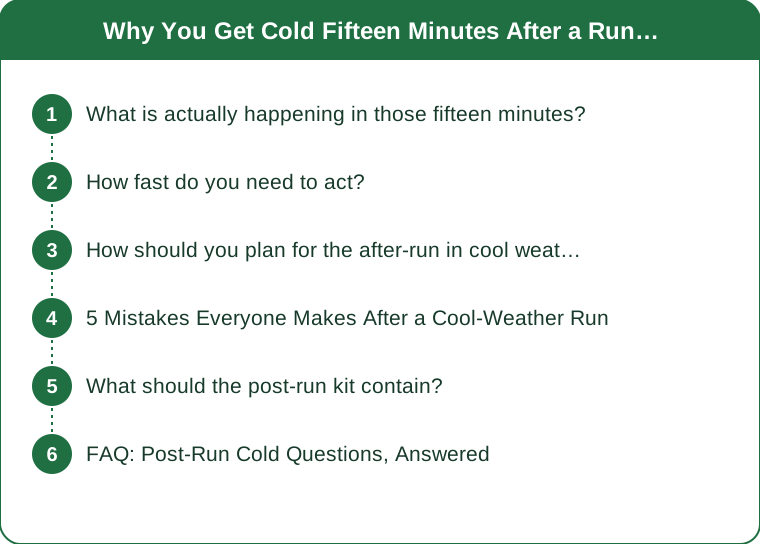
What is actually happening in those fifteen minutes?
During exercise, heat production rises dramatically and your body responds by dilating skin blood vessels and sweating to shed it.
When you stop, heat production drops almost immediately. Muscle work ends; metabolic rate falls back toward baseline within minutes.
But the cooling mechanisms lag. Skin vessels stay dilated, sweat keeps evaporating, and your body continues shedding heat it is no longer producing.
Wet clothing is the largest single factor. Water conducts heat away from the body far faster than dry air does, and a saturated base layer is effectively a cooling garment.
Wind multiplies it. Evaporative cooling from wet fabric plus air movement is the same mechanism that makes a breezy 60F feel like 45F when you are damp.
And core temperature can continue falling for a period after exercise stops - the phenomenon often called afterdrop - which is why the chill deepens rather than levelling off.
How fast do you need to act?
The window is roughly five to ten minutes. Changing out of a wet base layer inside that window prevents nearly all of it; waiting twenty minutes means managing a chill instead of avoiding one.
Change the base layer first, even if you change nothing else. It is doing the most cooling.
Add a windproof shell immediately after, because wind is the multiplier and a shell costs almost nothing to carry.
Cover the head and hands early. They have high surface-area-to-volume ratios and lose heat disproportionately, and they are also where the chill is first noticed.
Get out of wet socks and shoes if you can, which people consistently leave until last and which matters more than expected on cold ground.
Warm liquid genuinely helps - less through the calories than through the vasodilation and the psychological effect, both of which are real.
And do not sit down in the wet layer. Sitting reduces movement-generated heat and puts a wet garment in prolonged contact with a large area of skin.
How should you plan for the after-run in cool weather?
Leave a dry layer in the car or at the finish. This is the whole strategy and everything else is a detail.
Carry a packable windproof shell on the run itself if it is cool. Modern shells pack to the size of a fist and weigh a few ounces.
Plan the run to finish near shelter rather than at the furthest point from it.
Do a proper cooldown rather than stopping abruptly - five minutes of easy walking keeps mild heat production going while circulation normalises.
Avoid standing around outside to chat post-run in cool weather while wet. Move the conversation indoors or change first; this is where most people actually get caught.
Shower reasonably soon rather than immediately, with warm rather than hot water - very hot water on cold skin is uncomfortable and can leave you feeling worse.
And plan for the temperature you will finish in, not the one you started in. Autumn evening runs commonly finish 10F cooler than they began.

5 Mistakes Everyone Makes After a Cool-Weather Run
Keeping the wet base layer on for the drive home. A twenty-minute drive in a soaked shirt with the heater on is somehow both hot and chilling, and it is the most common version of this mistake.
Adding a jacket over wet clothing. The jacket traps the wet layer against your skin and slows evaporation without stopping conduction. It feels like a solution for about four minutes.
Waiting until you feel cold to act. By the time you feel it, you are already fifteen minutes into the process. Layer up before the sensation arrives.
Skipping the cooldown entirely. Stopping abruptly drops heat production off a cliff while circulation is still fully dilated, which is exactly the worst combination.
Underestimating a short run. A 25-minute run produces plenty of sweat and the same afterdrop. People pack a change of clothes for a long run and skip it for a short one, and then get cold on the short one.
What should the post-run kit contain?
A dry base layer - long sleeve, which is the single most valuable item.
A packable windproof shell, which handles the multiplier.
A warm hat, disproportionately effective for its size and weight.
Dry socks, which cost nothing and are consistently forgotten.
A light pair of gloves for anything below about 55F.
A small towel to get sweat off the skin before layering, which matters more than adding another layer would.
And a warm drink in a flask if you are finishing somewhere without one. Two minutes of preparation before leaving the house prevents the entire problem. This is general information, not medical advice.
FAQ: Post-Run Cold Questions, Answered
Why am I colder after the run than during it?
Because heat production stops immediately when you stop moving while cooling mechanisms - dilated skin circulation, evaporating sweat, wet clothing - keep working for another ten to twenty minutes.
How quickly should I change out of running clothes?
Within about five to ten minutes if it is cool. The wet base layer is doing the most cooling, so change that first even if nothing else.
Does putting a jacket over wet clothes help?
Barely. It traps the wet layer against your skin and slows evaporation without stopping conduction. Change the wet layer, then add the jacket.
Is shivering after a run a problem?
Mild shivering that resolves once you are dry and warm is a normal thermoregulatory response. Persistent shivering, confusion or difficulty warming up warrants medical attention.
Should I shower immediately?
Soon is good; immediately is not necessary. Use warm rather than very hot water, since very hot water on chilled skin is uncomfortable and can leave you feeling worse afterwards.
Do I need a change of clothes for a short run?
Yes, if it is cool. Short runs produce plenty of sweat and the same afterdrop, and the short run is the one people skip preparing for.
TL;DR:
- Heat production stops the moment you stop; cooling continues for ten to twenty minutes.
- Wet clothing is the biggest factor - water conducts heat away far faster than air.
- Change the base layer within five to ten minutes, before you feel cold rather than after.
- Add a windproof shell immediately after; wind is the multiplier on everything else.
- A jacket over wet clothes traps the cooling layer against your skin and barely helps.
- Pack for a short run the same as a long one - the afterdrop is identical.
Leave a dry layer in the car. That one habit solves most of it. This is general information, not medical advice.
Keep Reading
This article is for general informational and styling purposes only. Fit, sizing, and product availability may vary.