The Post-Run Coffee Stop Outfit, When You Are Still Actively Sweating

Quick Answer: Sweating peaks 5 to 10 minutes after you stop, because your core temperature is still falling. Change the base layer immediately, keep an absorbent mid-layer on for the first fifteen minutes, and do not add a windproof shell until sweating has actually stopped — trapping it is what makes you cold and damp for an hour.
You finished the run feeling fine and walked straight into the cafe.
Four minutes into the line, the sweating started properly, and now the shirt is soaked and the air conditioning is doing the rest.

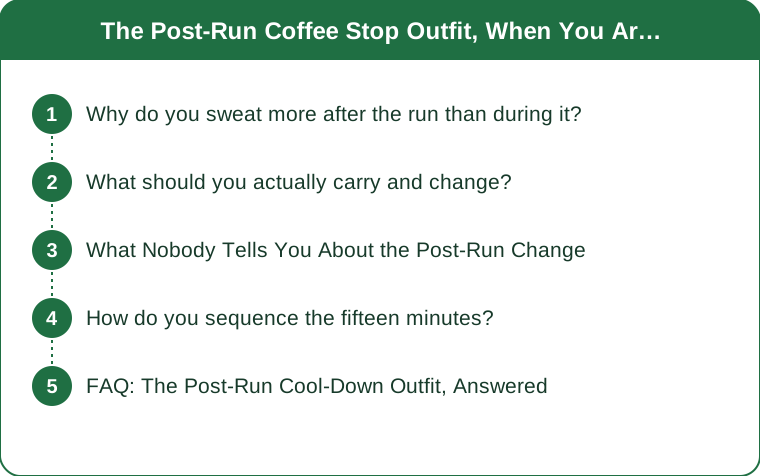
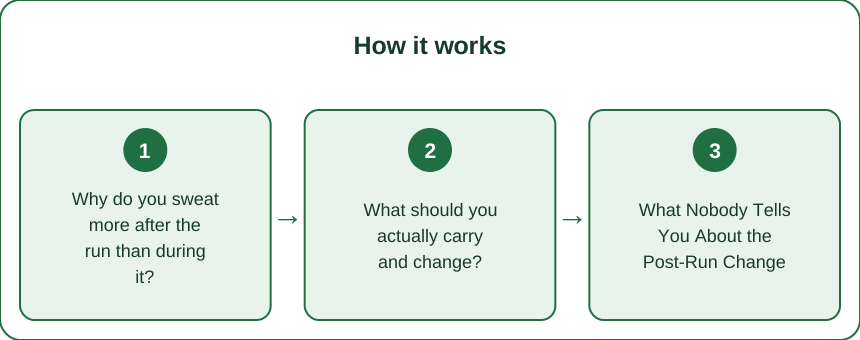
Why do you sweat more after the run than during it?
Because heat production stops instantly and heat dissipation does not.
Core temperature keeps climbing briefly after you stop. Muscle heat generated in the last minutes of the run is still moving into your bloodstream, so your body keeps sweating to shed it. The peak commonly lands 5 to 10 minutes after the finish.
Airflow disappears the moment you stop moving. Running creates its own breeze that evaporates sweat as it forms. Standing still removes it, so the sweat sits on your skin instead of leaving, which is why it feels like more sweat rather than the same amount.
Indoor air is usually more humid than you expect. A cafe full of steam wands is a poor evaporation environment. Sweat that would have cleared outdoors in three minutes stays on the skin for fifteen.
Then the cooling overshoots. Once evaporation does catch up, a wet shirt against skin in air conditioning pulls heat away faster than your now-cooling body wants, and you go from too hot to genuinely cold in a few minutes.
Cool mornings make this worse, not better. A brisk 55-degree morning means you ran harder without noticing the heat load, then stopped into air that chills a wet layer very efficiently.
What should you actually carry and change?
Two small items solve most of it, and neither takes much room.
A dry base layer, not a jacket. A spare technical tee weighs almost nothing and does more than any outer layer. Change it before you sit down, not after.
A small towel for the back of the neck and the hairline. Those two areas carry a disproportionate share of the residual heat. Thirty seconds there shortens the whole sweating tail noticeably.
A merino or merino-blend mid-layer for the first fifteen minutes. Wool holds up to 30 percent of its weight in moisture without feeling wet against skin, which is exactly the property you need while your body finishes what it is doing.
Change socks and shoes if the stop lasts more than twenty minutes. Feet lose heat fast and damp socks in a cool cafe are the single most common source of post-run chill.
Deodorant and a dry hair tie, honestly. Small, unglamorous, and the difference between wanting to stay for a second coffee and wanting to leave.

What Nobody Tells You About the Post-Run Change
Changing too early traps you. If you put a dry shirt on at minute one and you are still sweating at minute seven, you now have two damp shirts. Wait until the sweating rate has visibly slowed, usually 5 to 8 minutes, unless you are cold.
A windproof shell is the wrong first layer. It stops evaporation completely, which keeps the sweat on your skin. Save it for after the sweating has stopped, or use something breathable in the meantime.
Cotton is not automatically wrong here. For a stationary twenty minutes indoors, a cotton tee’s absorbency is actually useful — it pulls moisture off the skin. It becomes the wrong choice the moment you go back outside into cool air.
Sitting outdoors beats sitting inside for the first ten minutes. Moving air finishes the evaporation faster than a still, humid room, even if the air is cooler.
The smell comes from the bacteria, not the sweat. Fresh sweat is close to odorless. What you notice at minute twenty is bacterial breakdown on fabric, and synthetic fibers hold onto the responsible compounds far more stubbornly than wool or cotton — which is why the same shirt smells worse on the second wear.
How do you sequence the fifteen minutes?
Order matters more than any single item you bring.
Minute 0 to 2: keep walking. Do not sit down immediately. Continued gentle movement maintains the airflow that clears the first wave of sweat.
Minute 2 to 3: towel the neck, hairline, and forearms. Fastest possible reduction in surface moisture.
Minute 5 to 8: change the base layer. By now the sweating rate has dropped enough that a dry shirt stays dry.
Minute 8 to 15: add the mid-layer only if you feel cooling start. Adding it early undoes everything above. If you are shivering, layer immediately — that is a different signal.
After 15 minutes: shell or jacket if you are heading back outside. At this point the evaporation is essentially finished and windproofing is helping rather than hurting. If you experience dizziness, an unusually rapid heart rate that does not settle, or you stop sweating while still feeling hot, treat that as a reason to sit down, take fluids, and seek help rather than a wardrobe question. This is general information, not medical advice.
FAQ: The Post-Run Cool-Down Outfit, Answered
How long does post-run sweating usually last?
For a moderate run in mild weather, roughly 10 to 20 minutes, with the peak around 5 to 10 minutes after finishing. Harder efforts and warmer conditions push both numbers up, and standing in still indoor air stretches the tail considerably.
Should I shower before coffee if I can?
If it is convenient, yes — but a quick rinse only helps if you are actually cooled down first. Showering while still generating heat often restarts sweating within minutes of getting dressed. A five-minute walk before the shower makes it far more effective.
Why do I get cold so suddenly at the cafe?
A wet layer plus air conditioning creates evaporative cooling right when your core temperature has already come back down. Changing the base layer before you sit removes the mechanism entirely, and dry socks handle most of what is left.
TL;DR:
- Sweating peaks 5 to 10 minutes after you stop, so changing at minute one usually wastes a dry shirt.
- Keep walking for two minutes, towel the neck and hairline, then change the base layer around minute 5 to 8.
- Do not add a windproof shell until sweating has stopped; it traps moisture against your skin.
- Dry socks matter more than a dry top for how cold you feel twenty minutes in.
A spare tee, a small towel, and the right order. That is the whole system, and it fits in a running belt.
Keep Reading
This article is for general informational and styling purposes only. Fit, sizing, and product availability may vary.