Why Your Post-Run Outfit Feels Wrong Twenty Minutes Later

Quick Answer: Your post-run outfit stops working because core temperature keeps falling for 20 to 40 minutes after you stop, while sweat continues evaporating from skin and hair. You dress at the warmest moment on the curve and then live in that outfit at the coldest. The fix is to dress for where you will be in half an hour, not how you feel now: dry base layer first, one layer more than feels necessary, and change before you cool rather than after.
You finish, you are hot, you pull on the lightest thing in the bag.
Twenty minutes later, in a café, you are quietly freezing and cannot work out when it happened.
You dressed for the wrong minute.

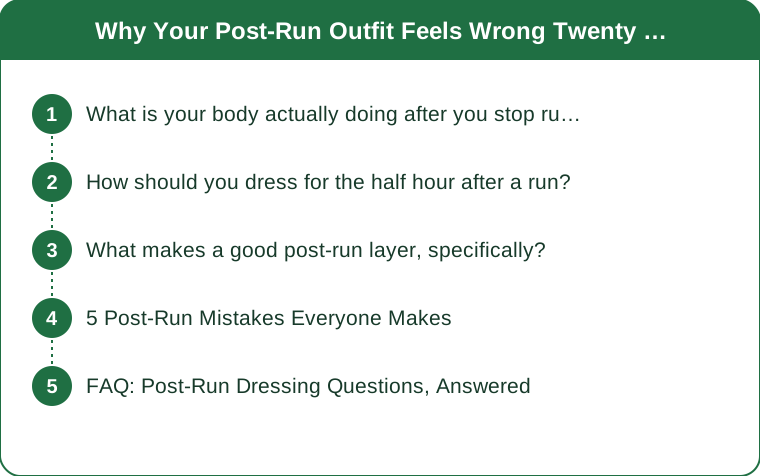
What is your body actually doing after you stop running?
The temperature curve after exercise is not a straight line down, and that is the whole problem.
Core temperature keeps rising briefly, then falls for 20 to 40 minutes. Blood returning from dilated skin vessels continues offloading heat well after the effort ends.
Sweating continues after you stop. Sweat rate drops but does not cease immediately, so a base layer that felt merely damp at the finish is wetter ten minutes later.
Evaporative cooling is powerful and unwelcome. Evaporating sweat removes a great deal of heat, which is exactly what you wanted while running and exactly what you do not want afterwards.
Skin blood flow reverses. Vessels constrict as you cool, so hands and feet get cold disproportionately fast even while your torso feels fine.
Wet hair is a major heat leak. A wet head loses heat rapidly and is the most commonly ignored factor in post-run chill.
And your perception lags reality. The subjective sense of being hot persists several minutes past the point where you have actually started losing heat too fast.
How should you dress for the half hour after a run?
The rule is to dress for minute thirty, not minute one.
Change the base layer first, always. A dry shirt under the same jacket is worth more than a warmer jacket over a wet one. Wet fabric against skin is where the heat goes.
Add one layer more than feels right. At the moment of changing you are still on the warm part of the curve. If it feels correct now, it will be insufficient shortly.
Deal with the head. A dry cap or a simple beanie in the bag solves more post-run chill than any upper-body layer.
Change socks if the run was wet. Feet cool fastest and are the hardest to warm back up once cold.
Layer for removal, not addition. A zip-through is far more useful than a pullover because you can dump heat gradually rather than in one step.
Keep the change kit packed permanently. Dry shirt, light layer, cap, socks. The reason people skip the change is not knowledge, it is that the bag was not ready.

What makes a good post-run layer, specifically?
The requirements are different from running kit, and the pieces are usually different too.
It should be loose. Compression is useful during running and counterproductive after, when you want air to move and skin to dry.
Natural or blended fibres over pure synthetics. Merino and cotton blends hold warmth when slightly damp better than lightweight technical polyester, which is engineered to move moisture rather than retain heat.
A full-length zip. Non-negotiable for temperature management on the walk home.
Something you can sit in. Half the post-run half hour is spent stationary, and stationary is where you cool.
A hood earns its place. It is the lightest way to solve the wet-head problem without carrying a separate hat.
Seasonal note: the shift from late summer to early autumn is the highest-risk period of the year for this. Air temperature is still pleasant at the finish, but evenings and shaded mornings now cool much faster than they did in July, and most people are still running with a summer kit bag.
5 Post-Run Mistakes Everyone Makes
Staying in the wet base layer. The single biggest contributor to post-run chill, and the easiest thing to fix.
Dressing for how you feel at the finish. You are at the peak of the temperature curve. Whatever feels right will be too little in fifteen minutes.
Stretching before changing. Ten minutes of stretching in a wet shirt is ten minutes of evaporative cooling. Change first, stretch after.
Ignoring hair and hands. Both are disproportionate heat losses relative to how little it costs to cover them.
Going straight into air conditioning. A cooled café or car accelerates the drop dramatically, and you will not notice until you are already cold.
And the one that surprises people: the post-run coffee makes it worse. Sitting still indoors is when the curve bottoms out — that is exactly when the extra layer is needed most.
FAQ: Post-Run Dressing Questions, Answered
How soon should I change after a run?
Within five to ten minutes, before the cooling really starts. Changing after you feel cold is already late.
Is it bad to stay in wet running clothes?
Mostly a comfort and chafing issue rather than a health one, but the chill and skin irritation are real reasons to change promptly.
Does a hot drink actually warm me up?
Marginally, and mostly it feels good. A dry layer contributes considerably more actual heat retention.
Should I shower straight away?
If convenient, yes. A warm shower shortcuts the whole cooling curve. Otherwise dry clothes do the same job more slowly.
Why do my hands get cold when my body feels warm?
Skin blood flow constricts as you cool, and the extremities lose circulation first. Light gloves in the bag from September onward solve it.
What if I run in the evening and go straight home?
You still cool on the walk. The change kit matters even for a five-minute journey, especially now that evenings are cooling faster.
TL;DR:
- Core temperature keeps falling for 20 to 40 minutes after you stop, so dressing for the finish line is dressing for the wrong minute.
- Change the wet base layer first — it does more than any warmer outer layer.
- Add one layer more than feels necessary and cover the head.
- Choose loose, zip-through, slightly warmer than expected pieces you can sit still in.
- Late summer into autumn is the highest-risk window; update the kit bag now.
Pack a dry shirt, a cap and spare socks tonight and leave them in the bag. That is the whole fix.
Keep Reading
This article is for general informational and styling purposes only. Fit, sizing, and product availability may vary.