Why Your Post-Run Layer Should Go On Before You Feel Cold

Quick Answer: Once you stop running, blood flow redistributes away from working muscles and your damp clothing starts pulling heat off your skin through evaporation. By the time you feel cold, that process has been running for several minutes. Adding a dry layer immediately — before the chill registers — keeps you from spending the rest of the day quietly under-recovered.
You finish, you feel great, you stretch a bit, you check your splits. Eight minutes later you’re shivering in a doorway wondering how that happened so fast. The answer is that it didn’t happen fast — it started the second you stopped.

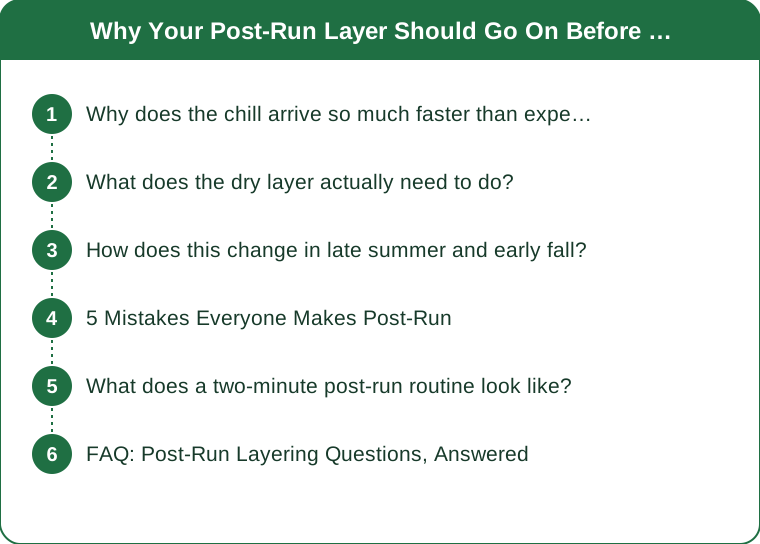
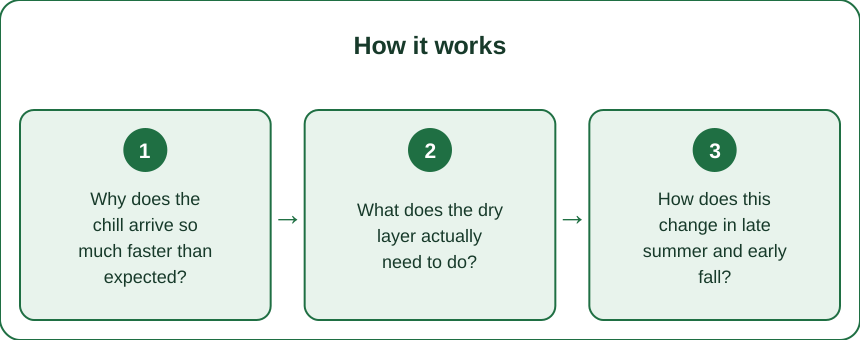
Why does the chill arrive so much faster than expected?
During a run, your body is producing far more heat than at rest and shedding it through sweat. The moment you stop, heat production drops off almost immediately, but the sweat is still there and still evaporating.
Evaporation from damp fabric continues pulling heat off your skin long after you’ve stopped generating any, and that’s on top of blood redistributing away from your skin surface. The result is a temperature drop that begins immediately but only becomes conscious once it’s already substantial — which is exactly the wrong feedback loop for deciding when to layer.
What does the dry layer actually need to do?
Two jobs, in order. First, get a dry surface between you and the air so evaporative cooling has less to work with. Second, insulate.
Most people reach for a thick hoodie over a soaked shirt, which does the second job and completely skips the first. A dry base layer under a modest outer layer outperforms a heavy layer over wet fabric, every time, and it’s the specific reason a small dry t-shirt in a bag beats a bulky jacket for post-run comfort.
How does this change in late summer and early fall?
This is the season the timing goes wrong most often, because the air still feels warm at the finish. A 70-degree morning feels perfectly pleasant standing still in dry clothes and genuinely cold standing still in soaked ones.
The practical rule for transitional weather: if you sweated through the shirt, you need the change regardless of the temperature reading. Runners get caught by this repeatedly in September, when the calendar says layering season hasn’t started but the physiology says otherwise.

5 Mistakes Everyone Makes Post-Run
Mistake 1: waiting for the cold signal. The signal is late by design. Layer on a timer, not on a feeling.
Mistake 2: layering over the wet shirt. Insulating damp fabric traps a cold, wet surface against your skin instead of removing it.
Mistake 3: sitting down in a car immediately. A cooling car seat with wet clothing accelerates the whole process and adds a stiff lower back to it.
Mistake 4: cotton as the change layer. Cotton is fine to change into when you’re staying warm, but it holds moisture badly if you’re still sweating from residual heat.
Mistake 5: the socks. The fourth one gets talked about; the socks almost never do. Damp feet in shoes after a run are the single most common source of that lingering can’t-get-warm feeling on the drive home.
What does a two-minute post-run routine look like?
Keep it small enough to actually do. A dry shirt, dry socks, and one packable layer in a bag by the door covers nearly every scenario from July through October.
Order matters: change the shirt first, then add the layer, then deal with everything else. If you’re heading somewhere before showering, adding a lightweight beanie in cooler weather does a disproportionate amount of the work, since a meaningful share of heat loss happens from the head and neck when the rest of you is covered.
FAQ: Post-Run Layering Questions, Answered
Does staying cold after a run actually affect recovery?
Direct effects on muscle recovery are modest, but being persistently chilled increases muscle tension and general discomfort, and it makes post-run mobility work far less likely to happen at all.
Should I stretch before or after changing?
Change first. Stretching in wet clothes in cool air is where most people go from comfortably warm to shivering.
Is a cold shower after a run a bad idea in cool weather?
Cold exposure has its own uses, but stacking it on top of an already-cooling body in cool weather tends to overshoot. Warm first, then decide.
TL;DR:
- Evaporative cooling starts the moment you stop and peaks before you feel it
- A dry base layer beats a thick layer over wet fabric
- Transitional-season temperatures mislead — if you sweated through it, change it
- Dry shirt, dry socks, one packable layer covers most of the year
- Change before stretching, not after
The window is about two minutes wide and it closes quietly. Layer on the clock, not on the shiver.
Keep Reading
This article is for general informational and styling purposes only. Fit, sizing, and product availability may vary.