Why Your Post-Run Change Takes Longer in Humid Late-Summer Air
Quick Answer: Your core temperature keeps rising for several minutes after you stop, and your body keeps sweating until it has actually offloaded that heat. In humid air, sweat cannot evaporate efficiently - the air is already close to saturated - so cooling is slow and sweating continues far longer than it does in dry heat. Changing into dry clothes before you have finished cooling simply produces a second set of damp clothes.
The fix is sequencing: cool first, change second - and there is a clear signal for when to do it.
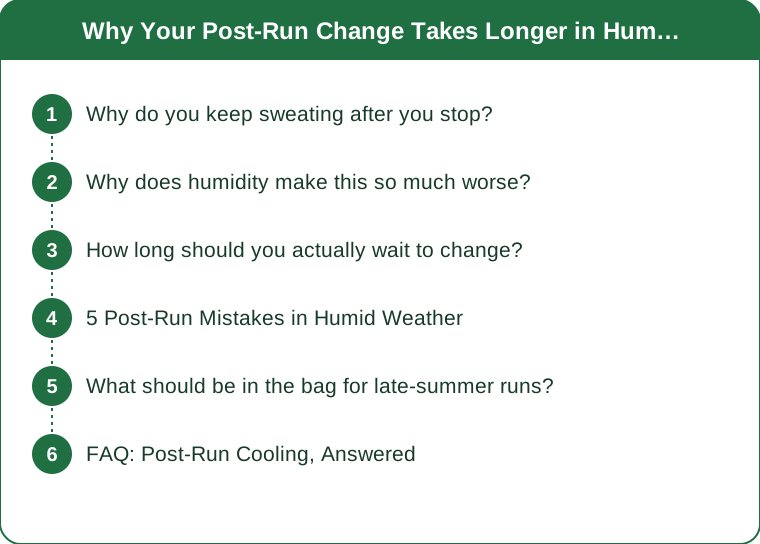
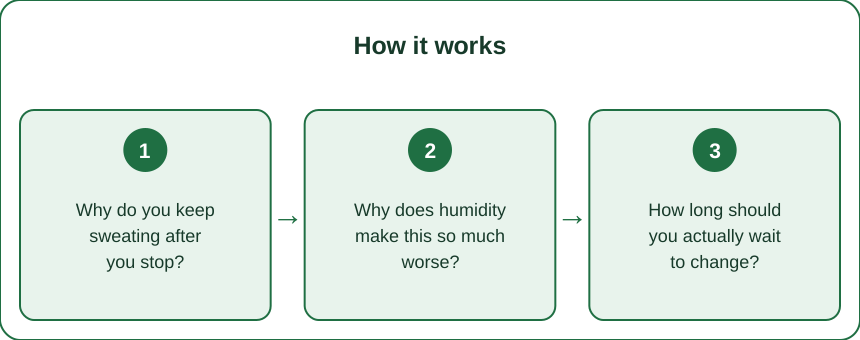
Why do you keep sweating after you stop?
Because the heat is still there, and it takes time to leave.
Exercise generates heat faster than your body can shed it, so you finish a run with a heat debt stored in your muscles and core. Core temperature typically continues rising briefly after you stop before it starts to fall.
Sweating is driven by core temperature, not by activity. Your body keeps producing sweat as long as it needs to shed heat - it does not switch off because you stopped moving. If anything the situation gets worse, because you have stopped generating the airflow that was helping evaporation.
Airflow is the biggest single loss when you stop. Running at a moderate pace creates continuous air movement across your skin, which drives evaporation. Standing still removes that instantly, and evaporative cooling drops sharply at exactly the moment you most need it.
Blood is also still redistributed to your skin. During exercise, blood flow shifts toward the skin to carry heat outward, and it takes several minutes to normalise. This is the same mechanism behind post-run dizziness if you stop abruptly.
So the period right after you stop is the worst combination: high core temperature, high sweat rate, and no airflow. The sweating you experience standing in the kitchen is not leftover - it is your body still working.
Why does humidity make this so much worse?
Because it disables the one cooling mechanism you are relying on.
Sweat cools you by evaporating, not by being wet. The phase change from liquid to vapour takes a large amount of energy, and it draws that energy from your skin. Sweat that drips off you has done essentially nothing.
Evaporation depends on the vapour pressure difference between your wet skin and the surrounding air. When the air is already close to saturated, that difference is small, so evaporation slows dramatically - and above roughly 75 percent relative humidity, evaporative cooling becomes markedly less effective.
Your body’s response to insufficient cooling is more sweat, not less. So humid conditions produce a higher sweat rate with a lower cooling return - you lose more fluid and cool more slowly at the same time.
Late summer is the worst version of this in many climates. Air temperature has dropped a little from peak summer, so it feels manageable, while humidity often stays high - and people run harder than they would have in July because it feels cooler.
The dew point is the number that actually matters. Air temperature alone is misleading. A dew point above roughly 65°F (18°C) is where most people notice cooling becoming difficult, and above 70°F (21°C) it is genuinely limiting - regardless of what the thermometer says.
Which explains the specific experience this article is about: a cool-feeling humid morning where you finish comfortably and then cannot stop sweating for twenty minutes.
How long should you actually wait to change?
Until the sweating slows - and there are better signals than the clock.
The rough range is 10 to 20 minutes after a moderate run, longer after a hard effort or in high humidity. But the signal is better than the timer.
Signal 1: your breathing has fully normalised. Not just ‘not gasping’ - back to a conversational, unconscious rhythm.
Signal 2: fresh sweat stops appearing on your forehead or forearms. Wipe your forearm dry and wait 30 seconds. If it is damp again, you are still cooling.
Signal 3: your skin feels cool to your own hand, particularly on the chest and neck.
Signal 4: the flushed feeling in your face has gone. Skin blood flow has normalised, which is one of the last things to settle.
What to do during that window matters as much as how long it is:
Keep moving gently. A slow walk maintains airflow and helps blood redistribute. Standing completely still is the worst option, and sitting down immediately is only slightly better.
Get airflow. Shade with a breeze beats still shade. A fan indoors is genuinely effective, and it is the most direct substitute for the airflow you lost when you stopped running.
Take the wet top off, but do not put the dry one on yet. Bare skin evaporates far better than skin under saturated fabric. A towel over the shoulders while you cool, then the dry layer once sweating slows, is the sequence that works.
Drink cool fluids. Internal cooling contributes meaningfully, and you need to replace fluid anyway.
Rinse with cool water if you can. Even splashing forearms, neck, and face accelerates the process noticeably - those areas have high blood flow near the surface.

5 Post-Run Mistakes in Humid Weather
1. Changing immediately. The mistake this article exists for. Dry clothes on a still-sweating body produce a second wet set within ten minutes, and now you have nothing dry left.
2. Going straight into air conditioning. It feels wonderful and it slows things down in an unexpected way: cold air causes skin blood vessels to constrict, trapping heat in your core. You feel cool while cooling more slowly, and often start sweating again once you leave.
3. Hot shower straight away. Raises skin temperature, prolongs sweating, and you frequently end up sweating in a towel afterwards. A cool or lukewarm shower after the initial cool-down works far better.
4. Sitting down in a car immediately. No airflow, seats that trap heat, and often direct sun through the glass. The worst cooling environment available, and a very common one. Windows open and a few minutes of walking first makes a real difference.
5. Skipping the sock and shoe change. Feet keep sweating too, and damp socks in shoes for the drive home is where blisters and skin irritation start. It is also the change that makes the biggest comfort difference for the least effort.
The one that surprises people: a damp technical top is often more comfortable during the cool-down than a dry cotton one, because the technical fabric keeps moving moisture to the surface where it can evaporate. Leave the technical top on, or go bare-shouldered with a towel - just do not put on the dry cotton until you are done.
What should be in the bag for late-summer runs?
Slightly different from a mid-summer kit, and different again from autumn.
A proper towel, not a small one. The single most useful item. Removing surface sweat mechanically speeds up the whole process when evaporation is not doing its job.
Dry socks, and dry shoes if the drive is long. The highest comfort-per-gram item in the bag.
A dry technical layer, not cotton. For the period after the cool-down. Cotton holds moisture against you if you start sweating again, which in humid conditions is a genuine possibility.
A light layer for after. Late-summer mornings and evenings can turn cool quickly, and once you have finally stopped sweating, you can chill fast - particularly if there is a breeze and you are still slightly damp.
Electrolytes, not just water. Humid-weather sweat rates are high, and replacing fluid without sodium over a long, sweaty run can leave you feeling worse rather than better.
Something for chafing. Humid conditions mean more sweat sitting on the skin and more friction. Prevention beforehand beats treatment afterwards, and the areas that chafe in humidity are often ones that never chafe in dry heat.
And a small practical one: a plastic bag for the wet kit. Not glamorous, and it prevents the single most common way a gym bag develops a permanent smell.
If you experience confusion, stop sweating while still hot, feel dizzy or nauseous, get a pounding headache, or your skin goes hot and dry, treat that as a possible heat illness and seek medical help - those are not normal post-run sensations. This is general information, not medical advice.
FAQ: Post-Run Cooling, Answered
Why do I keep sweating after I stop running?
Your core temperature keeps rising briefly after you stop and takes several minutes to come down. Sweating is driven by core temperature, not by activity, so it continues until the heat is actually shed - and stopping removes the airflow that was helping.
How long should I wait before changing?
Generally 10 to 20 minutes, longer after hard efforts or in high humidity. Better than the clock: wait until fresh sweat stops appearing on your forearms and your breathing is fully normal.
Why is humidity so much worse than heat?
Sweat cools you by evaporating, and evaporation needs dry air to move into. When air is near saturation, evaporation slows dramatically, so you sweat more and cool less. Dew point above roughly 65°F is where most people feel this clearly.
Should I go straight into air conditioning?
Not immediately. Cold air constricts skin blood vessels, which traps heat in your core - you feel cooler while cooling more slowly, and often start sweating again when you leave. Cool down in moving air first.
Is a cold shower a good idea?
Cool or lukewarm is better than either extreme. A hot shower raises skin temperature and prolongs sweating; a very cold one constricts surface vessels. Either way, cool down for a few minutes first.
What is the single most useful thing in the bag?
A large towel. Mechanically removing surface sweat does the job that evaporation cannot do in humid air, and everything after it works better.
TL;DR:
- Core temperature keeps rising briefly after you stop, and sweating continues until that heat is actually shed.
- Stopping removes the airflow that was driving evaporation, right when you need it most.
- Humidity disables evaporative cooling - above roughly 75 percent RH, or a dew point over 65°F, you sweat more and cool less.
- Wait 10 to 20 minutes before changing, and use the signal not the clock: no fresh sweat on a wiped forearm, normal breathing, cool skin, no facial flush.
- During the window: keep walking, get airflow, take the wet top off but hold the dry one, drink cool fluids, rinse forearms and neck.
- Avoid immediate air conditioning, a hot shower, and sitting in a hot car - all three slow cooling while feeling like relief.
- Bag essentials: a large towel, dry socks, a dry technical layer, a light layer for after, electrolytes, and a bag for the wet kit.
Cool first, change second. Doing it the other way round costs you a second set of clothes.
This is general information, not medical advice.
Keep Reading
This article is for general informational and styling purposes only. Fit, sizing, and product availability may vary.