Changing Your Socks and Shoes Matters More Than Changing Your Top

Quick Answer: Feet produce a large volume of sweat during a run and shoes hold it far longer than any upper layer, so leaving them on maintains a warm, damp, enclosed environment for hours. That is the condition associated with odor-producing bacteria, fungal issues, and blisters. Changing socks and shoes takes 30 seconds and addresses more of the actual problem than changing a shirt does.
You change the top because you can smell it and people can see it. Meanwhile the part of you that has been sealed in a warm damp box for an hour stays sealed for three more.

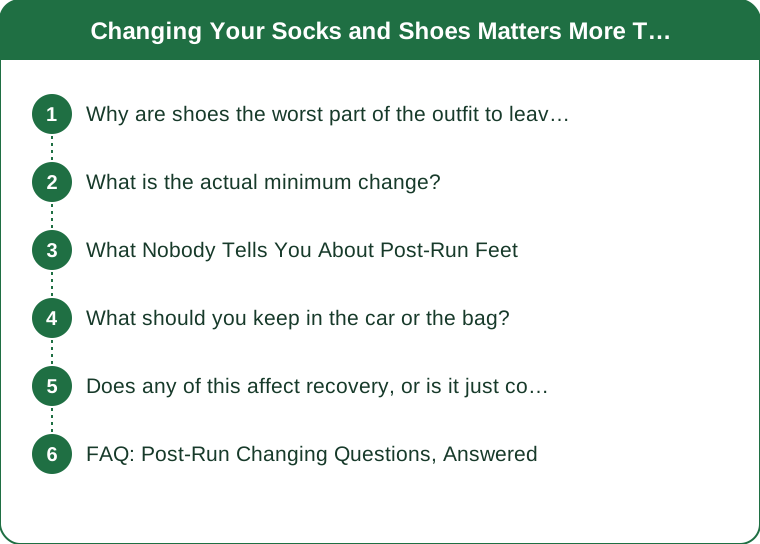
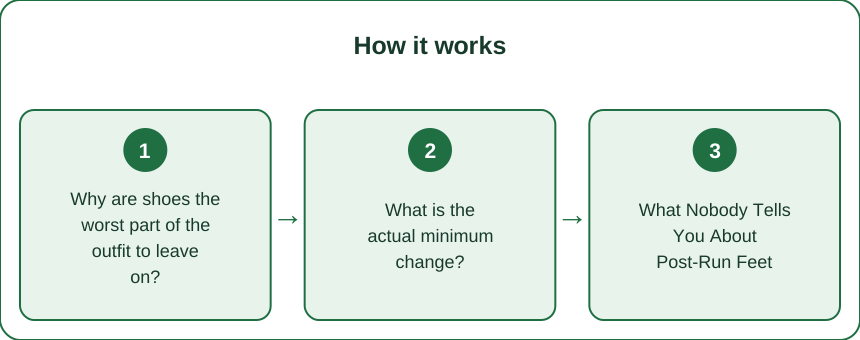
Why are shoes the worst part of the outfit to leave on?
Because they combine every condition that causes problems, and they release moisture more slowly than anything else you are wearing.
Feet have a very high density of sweat glands, and a run produces a substantial volume of sweat into the shoe and sock. A running shoe is designed to hold the foot securely, which means restricted airflow, and the midsole and insole foam absorb moisture and release it slowly.
A damp shirt in open air begins drying immediately. A damp shoe with a foot in it does not dry at all, because the foot keeps adding moisture and heat.
The result is a warm, humid, enclosed environment maintained for however long you keep them on. That is the specific condition that favors the bacteria responsible for foot odor, and it is also the condition associated with athlete’s foot and with skin maceration, where prolonged wetness softens and weakens the skin.
Macerated skin blisters and abrades far more easily, which is why the blister you get is often from the walk around the grocery store afterward rather than from the run.
What is the actual minimum change?
Socks and shoes, and if you only do one thing, socks.
A dry pair of socks in dry shoes takes about 30 seconds and resolves most of it. If you do not have spare shoes, dry socks in the same shoes is still a large improvement, because the sock is what sits against the skin and it is holding a meaningful share of the moisture.
After that, in priority order:
2. Anything with a waistband or a compression fit. Tight damp fabric against skin in a fold is the second-worst spot, and it is the origin of most post-run chafing and irritation.
3. The sports bra, for the same reason. Band and strap lines hold moisture against skin under pressure.
4. The top, which is the item most people change first and which is, physically, the least urgent because it is loose and dries in open air.
The ranking is close to exactly inverted from what people actually do, and the reason is visibility rather than physiology.
What Nobody Tells You About Post-Run Feet
Your shoes need 24 hours to dry properly, which means one pair is not enough if you run daily. Rotating two pairs is presented as a way to extend shoe life, and it does, but the bigger benefit is that each pair actually dries.
Removing the insole after a run roughly halves the drying time. It takes three seconds and almost nobody does it.
Do not dry shoes with direct heat. Radiators and hot air degrade midsole foam and adhesives. Newspaper, a fan, or a cedar insert works and does not shorten the shoe’s life.
Toenail problems and odor are often the same underlying issue. Prolonged dampness affects the nail bed as well as the skin, and people treat them as separate problems with separate products.
And the one that changes the habit for most people: it is not really about smell. Smell is the signal, not the problem. The problem is skin integrity, and someone who runs four times a week and stays in damp shoes for hours afterward is running a continuous experiment on their feet that eventually produces something more annoying than odor.

What should you keep in the car or the bag?
A small kit that lives there permanently, so the decision is never whether you brought it.
One pair of socks. Merino or synthetic, not cotton. They live in the bag and get replaced when used.
Slip-on shoes. The lower the effort to change, the more often it happens. Anything requiring laces will lose to convenience.
A small microfiber towel for feet specifically, separate from anything else.
A dry base layer or tee, mainly for the waistband and bra points above.
Wipes, which do less than people think for odor but do remove salt, and salt left on skin is itself an irritant under a waistband.
That kit fits in a small bag and covers the realistic scenario, which is not a shower but a five-minute change in a car park before doing something else. The perfect version of post-run hygiene involves a shower within thirty minutes. The version that actually happens is this one, and it captures most of the benefit.
Does any of this affect recovery, or is it just comfort?
Mostly comfort and skin health, with one genuine recovery link worth knowing.
Staying in damp clothing slows the return to normal body temperature in cool conditions and accelerates it too much in cold ones, both of which affect how comfortable and how stiff you feel an hour later. That is real but modest.
The more meaningful link is compression and circulation. Sitting in tight damp running gear, particularly in a car seat, for an hour after a run is not ideal for the lower-limb circulation that helps clear metabolic byproducts and reduce swelling. Changing into something loose is genuinely better than staying compressed, unless you are deliberately using recovery compression garments, which are designed for that purpose and are a different case.
The rest is comfort, skin, and not having to throw out shoes twice a year. Those are good enough reasons, and they do not need to be dressed up as performance benefits.
This is general information, not medical advice. Persistent itching, scaling between the toes, or nail changes are worth showing to a clinician or podiatrist rather than treating indefinitely with over-the-counter products.
FAQ: Post-Run Changing Questions, Answered
How soon does it actually matter?
The first thirty to sixty minutes are where most of the benefit is. Beyond about two hours in damp shoes you are into the range where skin maceration becomes a realistic concern for people who run frequently.
Do sock materials really make a difference?
Substantially. Cotton holds moisture and loses its shape when wet, which is why cotton socks are the most common cause of running blisters. Merino and synthetic running socks move moisture and keep their structure, and they are worth the modest cost difference.
Is it worth having dedicated post-run shoes?
An old pair of slip-ons kept in the car is enough. They do not need to be good; they need to be dry and easy to put on with wet feet, which rules out most laced shoes and anything tight.
TL;DR:
- Shoes hold moisture longest and dry slowest, keeping feet in a warm damp environment for hours
- Change socks first, then anything tight at the waist or under a bra band; the top is the least urgent
- Pull the insoles after every run and rotate two pairs so shoes actually dry
- Keep a permanent kit in the car: socks, slip-ons, small towel, dry layer
The post-run change everyone skips is the one that matters most. Spare socks in the car, thirty seconds, done.
Keep Reading
This article is for general informational and styling purposes only. Fit, sizing, and product availability may vary.