Why Changing Out of Running Clothes Actually Changes How Fast You Cool Down

Quick Answer: Sweat-soaked synthetic running fabric traps heat and moisture against the skin once you stop moving and airflow drops, slowing evaporative cooling, while changing into a dry layer restores that evaporative cooling effect and helps core temperature drop faster — meaning the change itself has a measurable physiological cooling benefit, not just a comfort one.
The run is over, but the shirt is still soaked, and staying in it feels harmless enough — except that damp fabric is actively working against how fast the body actually cools back down.
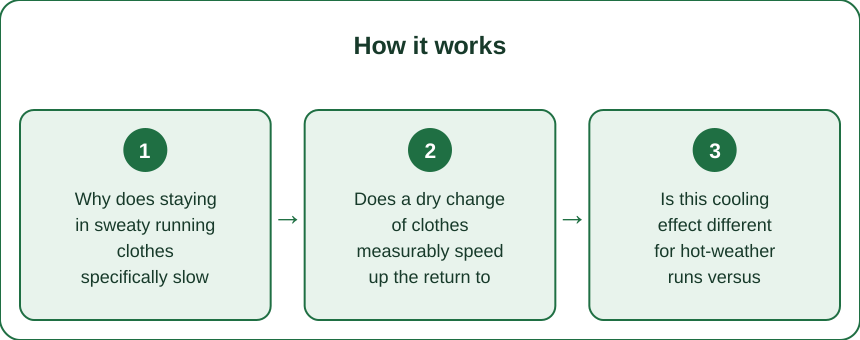
Why does staying in sweaty running clothes specifically slow down cooling after stopping?
While running, airflow across sweat-soaked skin drives fast evaporative cooling, but once movement stops that airflow drops sharply, and saturated fabric sitting against skin blocks further evaporation and traps heat close to the body, meaning the same shirt that helped cooling during the run can actively work against it once you’ve stopped.
Does a dry change of clothes measurably speed up the return to normal body temperature?
Yes — a dry layer restores unobstructed evaporative cooling at the skin surface and doesn’t hold a layer of trapped heat and moisture against the body, and studies on post-exercise recovery generally find that dry clothing supports faster core temperature normalization than remaining in saturated exercise gear.
Is this cooling effect different for hot-weather runs versus cold-weather runs?
The cooling benefit of changing is most pronounced after hot-weather runs where core temperature is elevated and evaporative cooling matters most, while after cold-weather runs the bigger risk of staying in wet gear is heat loss and chill rather than overheating, though changing into dry layers helps in both cases for different reasons.
5 Mistakes People Make With Post-Run Clothing Changes
Waiting too long after a hot run to change out of soaked gear, changing into another layer that’s also non-breathable, skipping a change entirely for a ‘quick errand’ that turns into an hour, not accounting for how much colder wet fabric feels once outdoor temperature drops post-run, and packing a full change but forgetting dry socks specifically, which affects comfort as much as the shirt does.
Does this matter as much for a short easy run as it does for a longer hard one?
The cooling effect is more noticeable after longer or harder efforts where core temperature rose more and sweat volume is higher, but even a shorter run in hot or humid conditions can produce enough sweat saturation that changing still measurably improves comfort and cooling speed.
FAQ: Post-Run Clothing and Cooling, Answered
How soon after a run should a change happen for the biggest cooling benefit?
Changing within roughly 15-20 minutes of finishing, once initial heavy sweating has slowed, captures most of the cooling benefit without needing to change mid-cooldown while still actively sweating heavily.
Does the fabric of the dry change matter, or is any dry shirt fine?
A breathable, moisture-wicking dry shirt supports faster cooling than a heavy cotton one, since cotton absorbs and holds moisture rather than moving it away from skin, even when starting dry.
Is it worth changing before doing errands right after a run?
Yes, both for cooling and for avoiding the discomfort of sweat-soaked fabric growing cold and clammy in air-conditioned indoor spaces, which is a common complaint after skipping the change.
TL;DR:
- Staying in sweat-soaked running clothes blocks evaporative cooling once airflow from movement stops
- A dry change restores that cooling effect and measurably speeds core temperature normalization
- The benefit applies differently but still matters in both hot and cold post-run conditions
- Changing within roughly 15-20 minutes after finishing captures most of the cooling benefit
That post-run change isn’t just about comfort or smell — it’s doing real physiological work to help the body cool back down faster than staying in soaked gear ever would.
Keep Reading
This article is for general informational and styling purposes only. Fit, sizing, and product availability may vary.