Why Your Post-Run Outfit Smells Long After You've Changed Out of It

Quick Answer: Lingering post-run odor usually comes from bacteria trapped in synthetic fibers (especially polyester), which hold onto sweat-derived compounds even after a regular wash cycle — the fix is a cold-water pre-soak with an odor-targeting detergent or a vinegar rinse, not just washing more frequently.
The smell isn’t really about how sweaty the run was. It’s about how well the fabric releases what soaked into it.

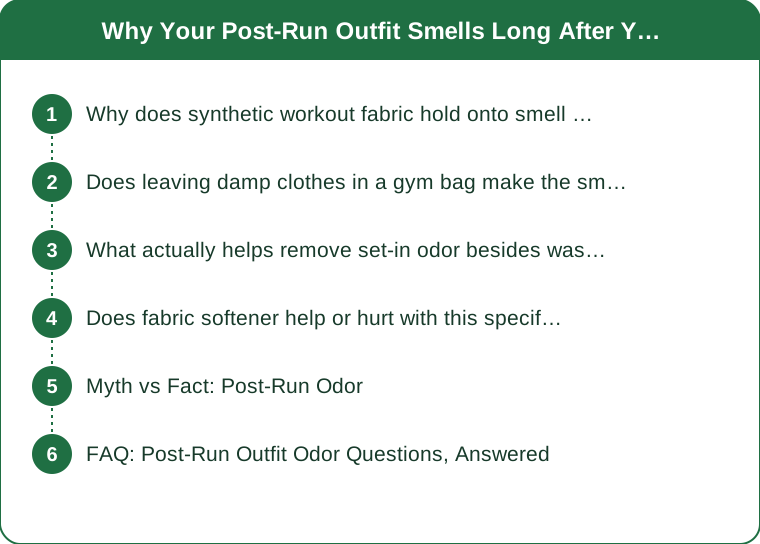
Why does synthetic workout fabric hold onto smell more than cotton?
Polyester and similar synthetics have a fiber structure bacteria can burrow into, making them harder to fully clean in a standard wash than cotton, which sweat and bacteria sit on top of rather than deep within.
Does leaving damp clothes in a gym bag make the smell worse?
Significantly, yes — letting sweaty fabric sit damp and compressed for even an hour lets bacteria multiply well beyond what a normal wash cycle can fully remove, which is often why the same outfit smells worse each subsequent wear.
What actually helps remove set-in odor besides washing more often?
A cold-water vinegar soak (roughly 1 cup per wash load) for 30 minutes before washing breaks down bacterial buildup that regular detergent alone often misses, especially for pieces worn multiple times without a full wash in between.

Does fabric softener help or hurt with this specific issue?
It tends to hurt — fabric softener coats fibers with a layer that traps odor-causing bacteria rather than releasing them, which is part of why ‘freshly washed’ synthetic workout wear can still smell after a few wears.
Myth vs Fact: Post-Run Odor
Myth: more detergent gets clothes cleaner and less smelly. Fact: excess detergent can leave residue that traps odor further — the right amount plus a pre-soak matters more than sheer quantity.
Myth: air-drying instead of the dryer prevents smell. Fact: air-drying slower in humid conditions can actually let bacteria multiply further before the fabric fully dries.
FAQ: Post-Run Outfit Odor Questions, Answered
Should sweaty workout clothes be washed immediately after every run?
Ideally within a few hours, or air them out fully unfolded if immediate washing isn’t possible, rather than balling them into a bag.
Does washing in hot water solve the odor problem better than cold?
Not necessarily — hot water can set some stains and doesn’t meaningfully improve bacteria removal over a proper cold pre-soak method.
Is it worth buying odor-resistant treated workout fabric?
For frequent runners, yes — antimicrobial-treated fabrics genuinely resist odor buildup longer, though the treatment does wear off gradually over many washes.
TL;DR:
- Synthetic fibers trap bacteria more stubbornly than cotton, causing lingering smell
- Letting damp clothes sit compressed in a bag accelerates bacterial buildup
- A cold vinegar pre-soak removes odor that regular detergent alone often misses
- Fabric softener traps rather than releases odor-causing bacteria in synthetics
Next laundry day, try a 30-minute vinegar pre-soak on your most-worn running outfit before the regular wash — it’s a small step that solves what extra detergent usually can’t.
Keep Reading
This article is for general informational and styling purposes only. Fit, sizing, and product availability may vary.